Sensing & robotic deconstruction · 2025
Contactless Material Assessment
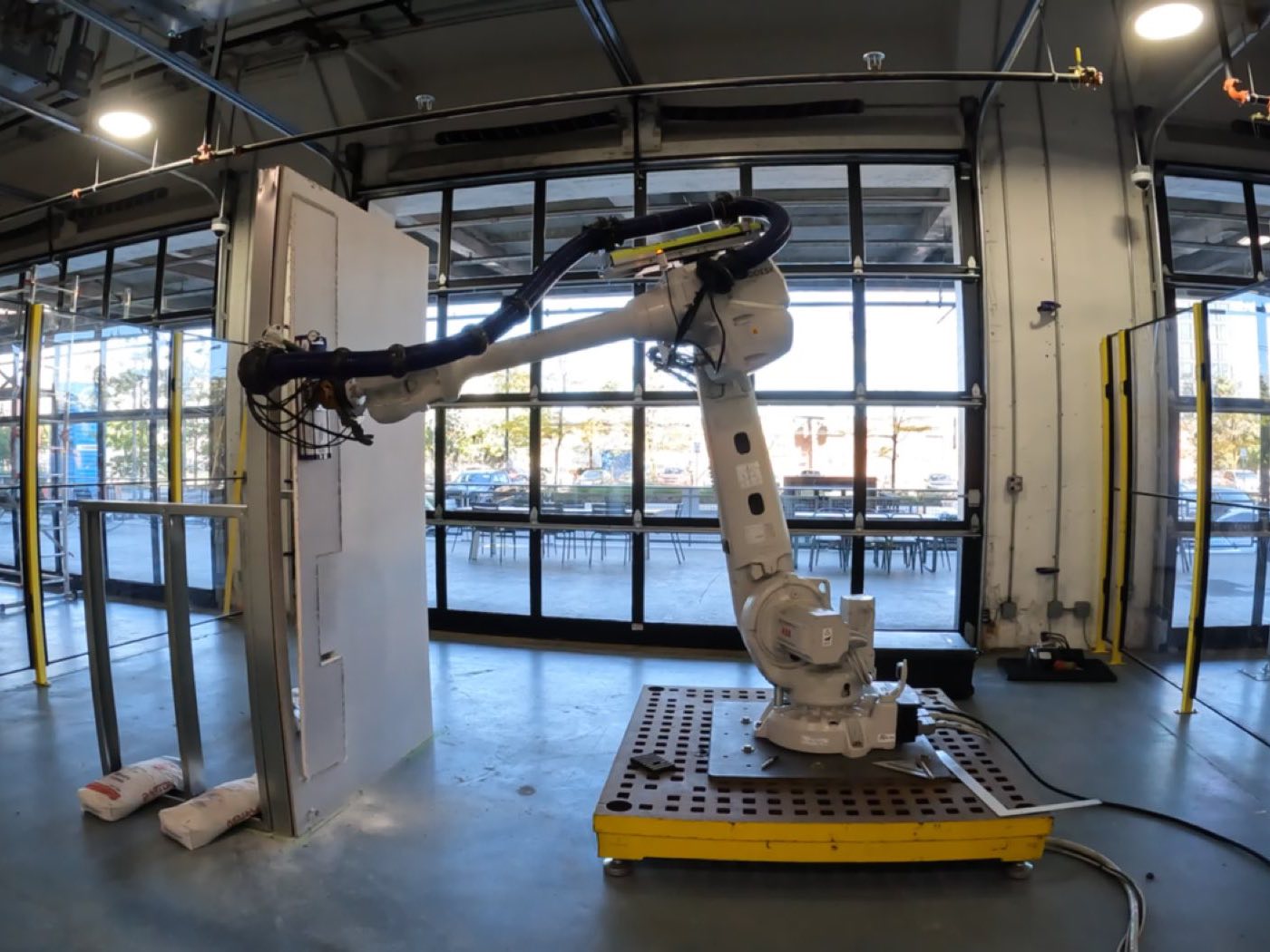
Buildings are full of material that is still good, and almost all of it gets landfilled, because nobody can tell what is behind the surface without destroying the surface to find out. This work reads a wall with thermal, RGB and depth sensing, works out where the studs and fasteners are, and then cuts and lifts the panel off intact so it can be used again.
- Role
- Co-author; robotic deconstruction cell
- Team
- Sophia Cabral, Mikita Klimenka, Fopefoluwa Bademosi, Damon Lau, Stefanie Pender, Lorenzo Villaggi, James Stoddart, James Donnelly, Peter Storey, David Benjamin. Autodesk Research, with Harvard GSD and MIT
- Paper
- A Contactless Multi-Modal Sensing Approach for Material Assessment and Recovery in Building Deconstruction. Sustainability 17(2), 585, 2025. Open access.
- Stack
- Thermal imaging, RGB and depth sensing, machine learning. ABB IRB 4600 on an IRC5 controller running External Guided Motion, with a cutting end effector and a vacuum gripper
Why drywall
Construction accounts for roughly 40% of global energy use, 35% of worldwide CO2 emissions, and somewhere between 45% and 65% of everything that goes to landfill. Drywall is the obvious place to start: there is an enormous amount of it, it comes out in sheets, and it is thrown away almost without exception.
It does not get thrown away because the gypsum is spent. It gets thrown away because taking a panel off a wall without knowing where the screws are means breaking it.
Seeing through the surface
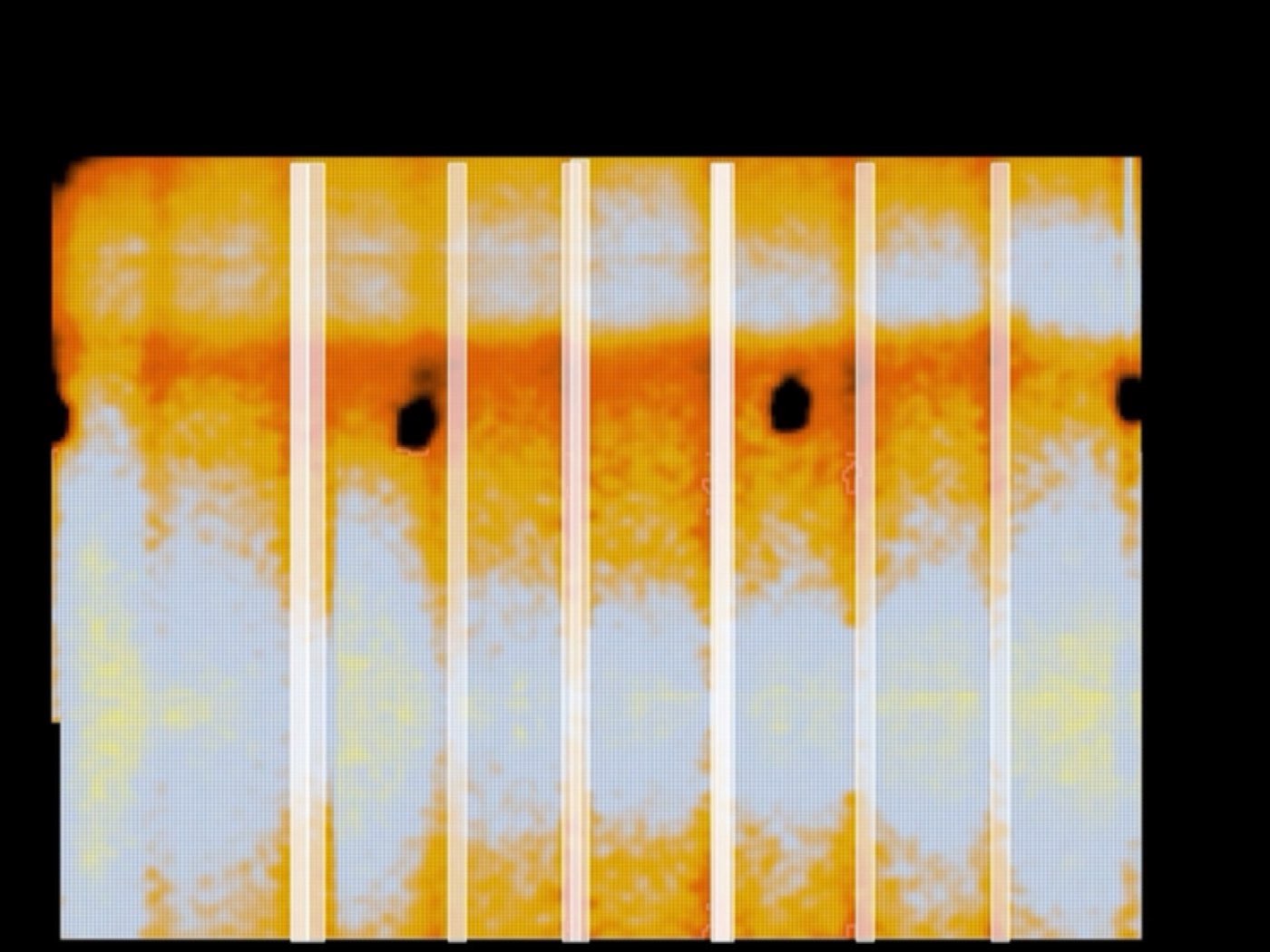
Studs and fasteners hold heat differently to the cavity between them, so a thermal camera sees structure the eye cannot. Registering those thermal frames against RGB, with lens distortion corrected, puts every stud and screw at a real coordinate on the wall. Depth sensing supplies the geometry around them.
What comes out is not a picture. It is a set of cut lines and fastener positions, mapped onto the wall the operator or the robot is about to work on.
Taking it apart
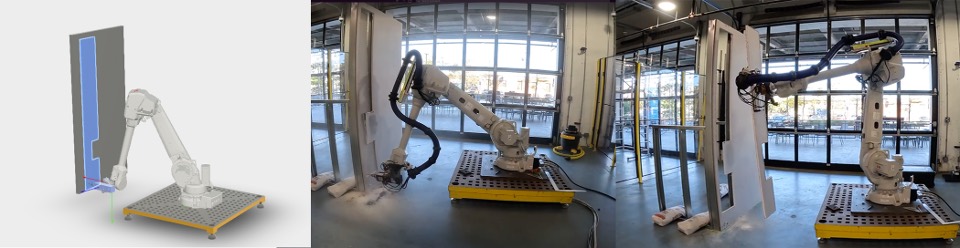
Three methods were tested against the same assessment data: cutting with a power saw, removing screws, and automated robotic deconstruction. All three were judged on one thing, whether the panel survived.
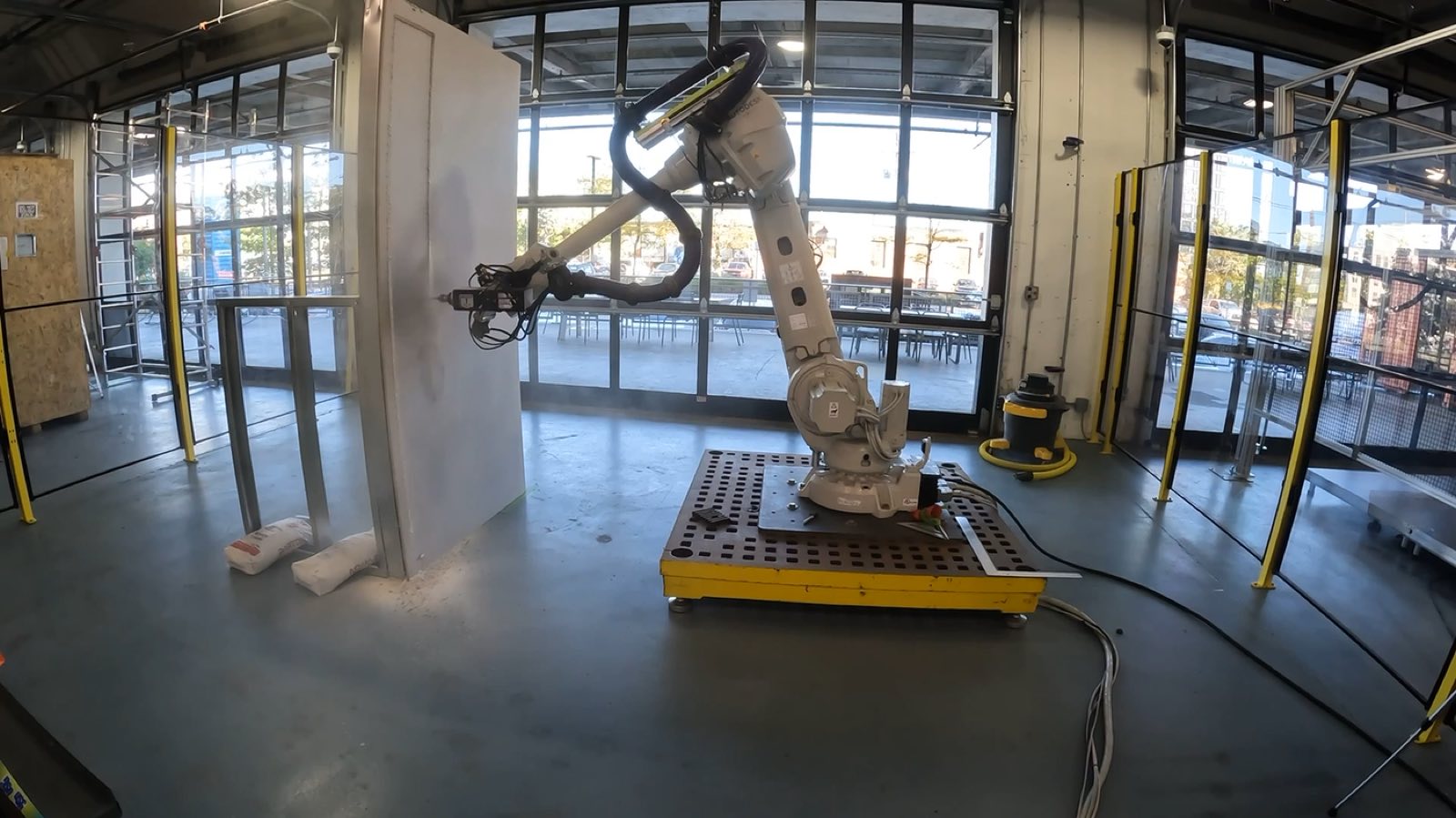
The robotic cell is an ABB IRB 4600, 40 kg payload and 2.55 m reach, on an IRC5 controller running External Guided Motion so the path can be driven from the sensing data rather than taught in advance. It cuts along the computed lines, then switches to a vacuum gripper and lifts the panel off the studs in one piece.
Result
The paper's finding is that contactless assessment paired with automated deconstruction is technically workable, cheaper than replacing the material, and better on carbon. It is an early step rather than a finished system, aimed at a real problem: buildings are the largest material stockpile we have, and we currently treat them as waste.