Robotic fabrication · OpenHOUse, University of Houston · 2024
Robotic Timber Truss Fabrication
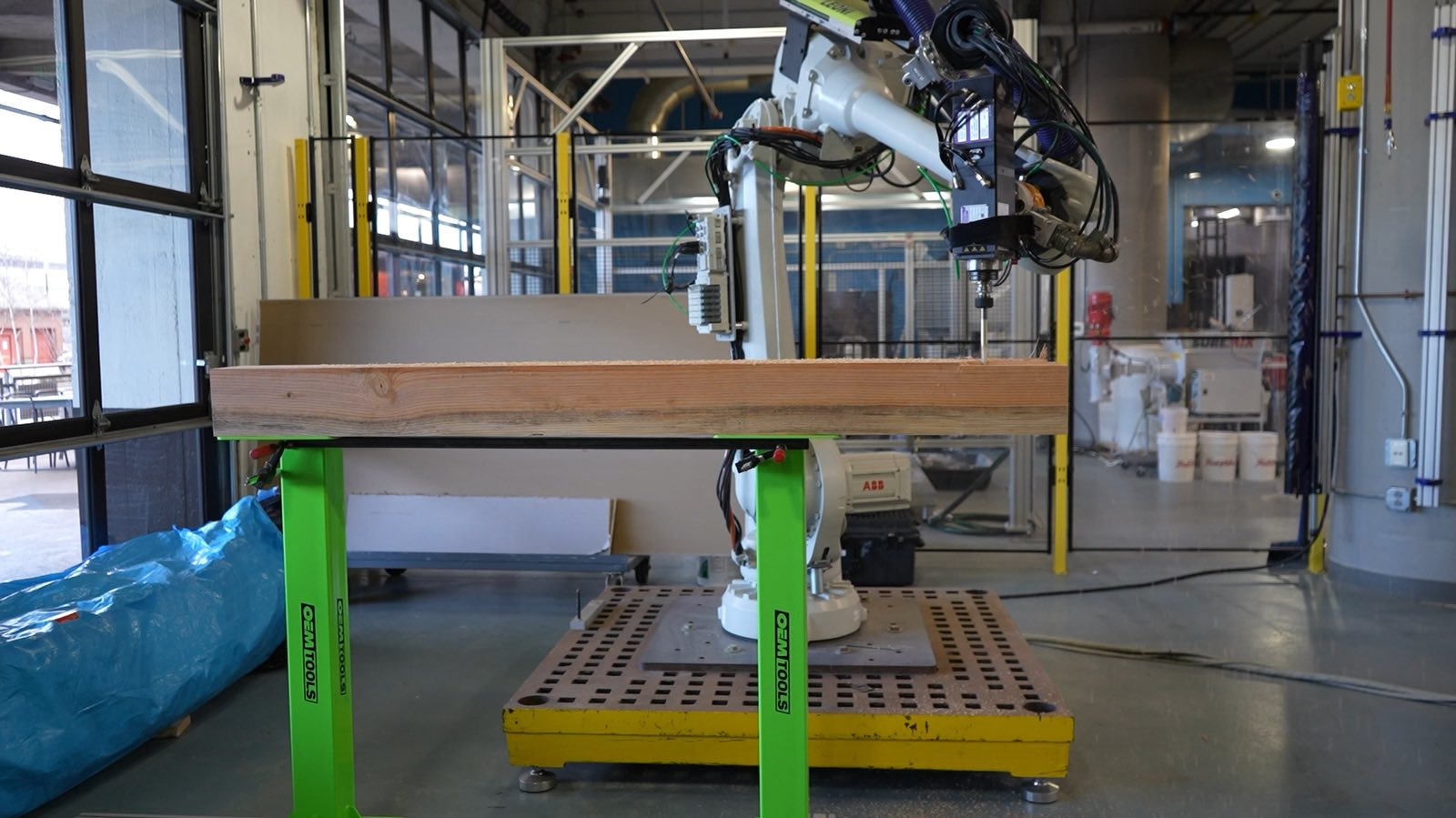
Structural timber joinery machined into full-size stock on a six-axis arm. The members were prototypes for OpenHOUse, the University of Houston's entry to the Gateway Decathlon, built at the Autodesk Technology Center in Boston during a Design Sprint residency.
- Project
- OpenHOUse, an entry to the Gateway Decathlon by the Gerald D. Hines College of Architecture and Design
- Team
- University of Houston faculty, with the Autodesk Technology Center, Boston
- Stack
- ABB six-axis arm with spindle, RAPID posts, PowerMill
- Read more
- University of Houston on OpenHOUse
What it was for
The Gateway Decathlon is a design-build competition in which university teams design, build and then exhibit a full housing unit near the Gateway Arch in St. Louis, judged across ten areas from energy performance to market viability. OpenHOUse is Houston's answer to Houston: rather than air-conditioning a whole house to one temperature, it uses passive and active systems to let different parts of the building sit at different temperatures.
That produced a saw-tooth roof, and a roof like that needs timber joinery that no catalogue supplies. Faculty came to Boston to find out whether the joints could be cut robotically before committing to them at full scale.
The problem
Timber is not a predictable stock material. It moves, it isn't square, and the joint still has to fit. Machining structural joinery into full-size members means the toolpath has to absorb the difference between the nominal model and the piece actually clamped on the table.
Scan, then cut
The cell scans the member in place before it cuts, so the toolpath is referenced to the piece actually clamped on the table rather than to the nominal model.